If you have used Google Maps to avoid traffic or asked Alexa to play a song, you have already experienced artificial intelligence at work. For most people, AI feels like something happening in the background, quietly making decisions without any human involvement. But in 2026, artificial intelligence has moved from the background to the centre of every major industry in India, and understanding what it actually is has become one of the most practically important things you can do as an IT professional or student.
India’s artificial intelligence market is growing at a pace that few other sectors can match, projected to reach $17 billion by 2027 and potentially $130.6 billion by 2032. For IT professionals and students in India, this is the signal that a structural shift in the workforce is underway. Now, the question is whether you are positioned to benefit from it.
AI for Beginners: Understanding the Technology Around Us
India is becoming a global leader in building and deploying it. The country is currently home to over 600,000 AI professionals, a number expected to approach 1.25 million within two years. India holds 16% of the global AI talent pool, making it the second-largest AI talent hub in the world after the United States.
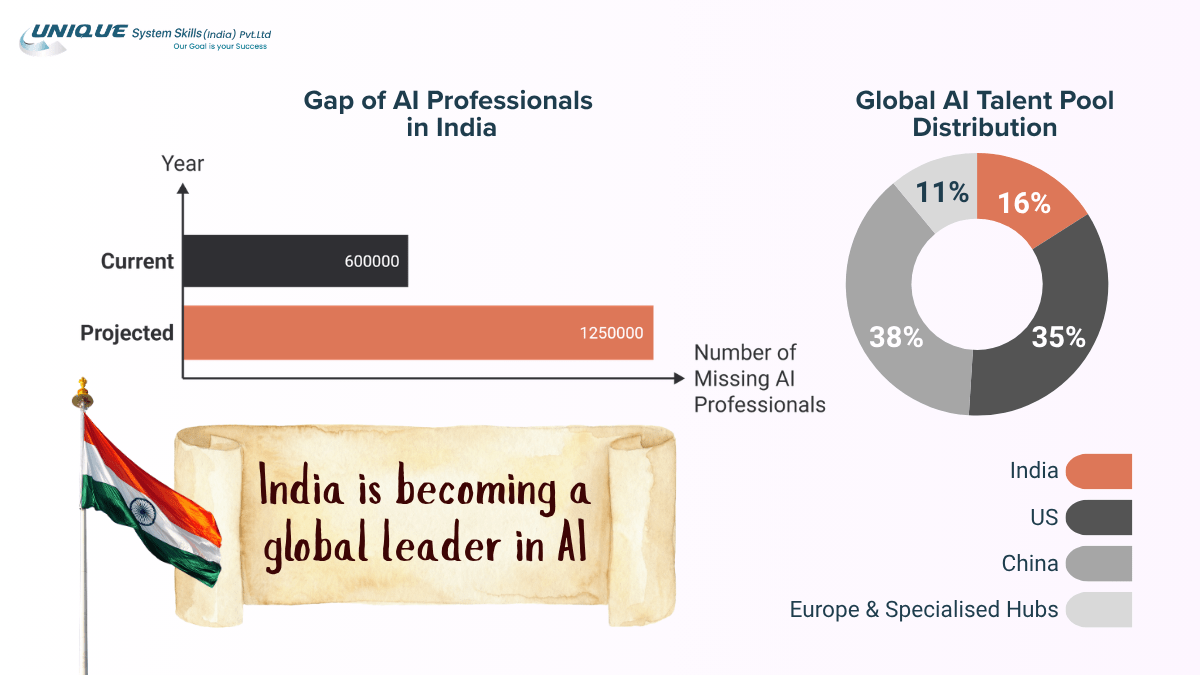
Global AI Talent Pool Distribution
But, before diving into careers and tools, let’s understand what artificial intelligence actually means. At its most basic, artificial intelligence refers to computer systems that can perform tasks that would normally require human intelligence like recognising speech, making decisions, identifying patterns in data, and generating text, images, or code.
The Artificial Intelligence Spectrum
Most of the AI you encounter every day falls into the category of Narrow AI, these are systems trained to do one specific thing very well. This includes your email spam filter, Spotify’s recommendation algorithm, and the facial recognition on your phone. They are impressive within their specific task but cannot do anything outside it. General AI is any system that can reason, learn, and apply knowledge across any domain the way a human can. It does not yet exist in a practical form, though it remains the long-term goal of organizations worldwide.
Generative AI
The GenAI wave that arrived in 2023 with ChatGPT and has accelerated through 2025 and 2026 represents a significant step forward within Narrow AI. Large Language Models (LLMs) like GPT-4 and Gemini can generate human-quality text, write code, summarise documents, and hold coherent conversations. When it comes to AI for beginners means trying to make sense of the landscape. The AI that is creating jobs and disrupting industries right now is not the science-fiction version. It is a set of powerful, specific tools that can be learned, built with, and deployed by skilled professionals.
Artificial Intelligence and Data Science: How They Work Together
One of the most common points of confusion for people entering this field is understanding the relationship between artificial intelligence and data science. They are related but distinct and getting the distinction right is important for choosing the right learning path.
Data Science is the process of collecting, cleaning, analysing, and interpreting large datasets to find patterns and generate insights. It answers questions like:
- Which customers are most likely to churn?
- Which products are most profitable by region?
- What factors predict a loan default?
Artificial intelligence takes those insights further by building automated systems that act on them, in real time, at scale, without requiring a human to review each output. A data scientist might analyse historical sales data to identify a pattern. An AI system uses that pattern to automatically adjust pricing every few minutes based on live demand signals.
In practice, the 2 fields overlap significantly. Most Data Science with AI training programmes in 2026 teach both together. This is because the skills involved (Python, statistics, machine learning, model deployment) are complementary rather than separate. Understanding both sides of the artificial intelligence and data science relationship is what allows professionals to build end-to-end intelligent systems. With the conceptual foundation clear, the practical next step is understand the specifics to build a real career in this space.
Artificial Intelligence Subjects: What You Actually Need to Learn
Breaking into the AI field requires moving past conceptual understanding and into a specific, structured curriculum. Here is how a modern artificial intelligence subjects roadmap is structured in 2026, based on what Indian employers are actively hiring for.
An AI learning path typically moves through 6 stages. It starts with Python Foundations (Pandas, NumPy, Matplotlib/Seaborn) for data handling and visualization, followed by a Machine Learning Basics (Linear Regression, Decision Trees, K-Means via Scikit-learn) for core algorithms. Next comes Deep Learning with TensorFlow/Keras for neural networks. Specialized domains like NLP and Computer Vision for language and image understanding are next. The path then covers Generative AI and LLMs including transformers, prompt engineering, OpenAI APIs, and RAG. The path ends with MLOps and Responsible AI, which focuses on deploying models reliably while ensuring fairness, privacy, and explainability.
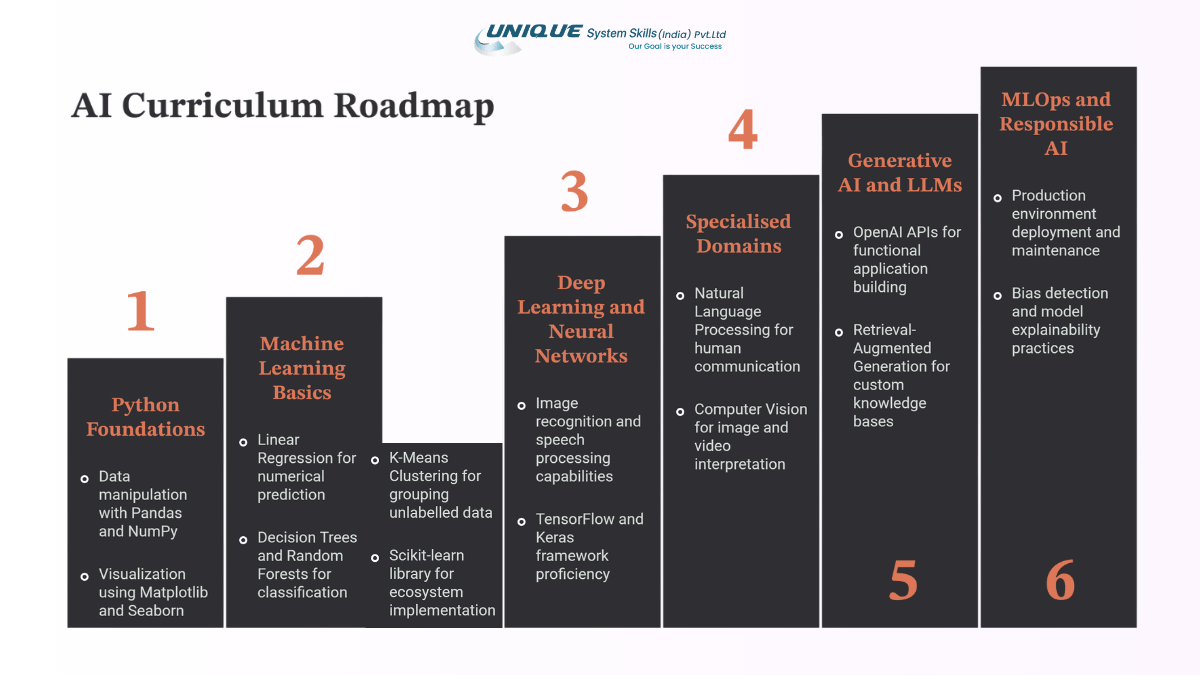
AI Curriculum Roadmap
USS’s AI Fundamentals Course covers the full breadth of these artificial intelligence subjects in a structured, hands-on programme designed for the 2026 Indian market.
Artificial Intelligence Tools: The Essential 2026 Stack
Understanding which artificial intelligence tools is one of the most practical decisions a learner can make, because the tool landscape is vast and not all tools carry equal weight in the Indian job market.
Scikit-learn implements virtually every classical algorithm you will need for data science and ML work, with a consistent, well-documented API that makes learning and iterating fast.
TensorFlow for production-grade model training and deployment and Keras as the higher-level interface that makes model building significantly more accessible, cover the deep learning layer
PyTorch is increasingly preferred in research environments and by organisations working with cutting-edge model architectures.
For Generative AI specifically
OpenAI APIs are the entry point for building LLM-powered applications — chatbots, document summarisers, code assistants, and content generators. Lang Chain and the emerging Lang Graph framework enable developers to build multi-step AI workflows and autonomous agents that can use tools, call APIs, and make sequential decisions — a capability that is commanding salary premiums at senior level across Bengaluru, Pune, and Hyderabad.
Hugging Face has become the go-to platform for accessing, fine-tuning, and deploying open-source language and vision models. Familiarity with the Hugging Face ecosystem is increasingly listed as a requirement in Indian AI job postings. For cloud deployment of AI applications, proficiency with AWS DevOps tools including SageMaker, EC2, and S3 connects the artificial intelligence tools layer to the production infrastructure layer that enterprise employers require.
Artificial Intelligence Projects: Building a Portfolio That Gets Noticed
In a competitive market where hundreds of candidates hold similar certificates, a documented portfolio of real artificial intelligence projects is what separates interview invitations from silence. Recruiters in 2026 increasingly want to see GitHub repositories and HuggingFace model cards rather than just degree certificates. This is why the projects you build during training are the most accessible way to create that portfolio from day one.
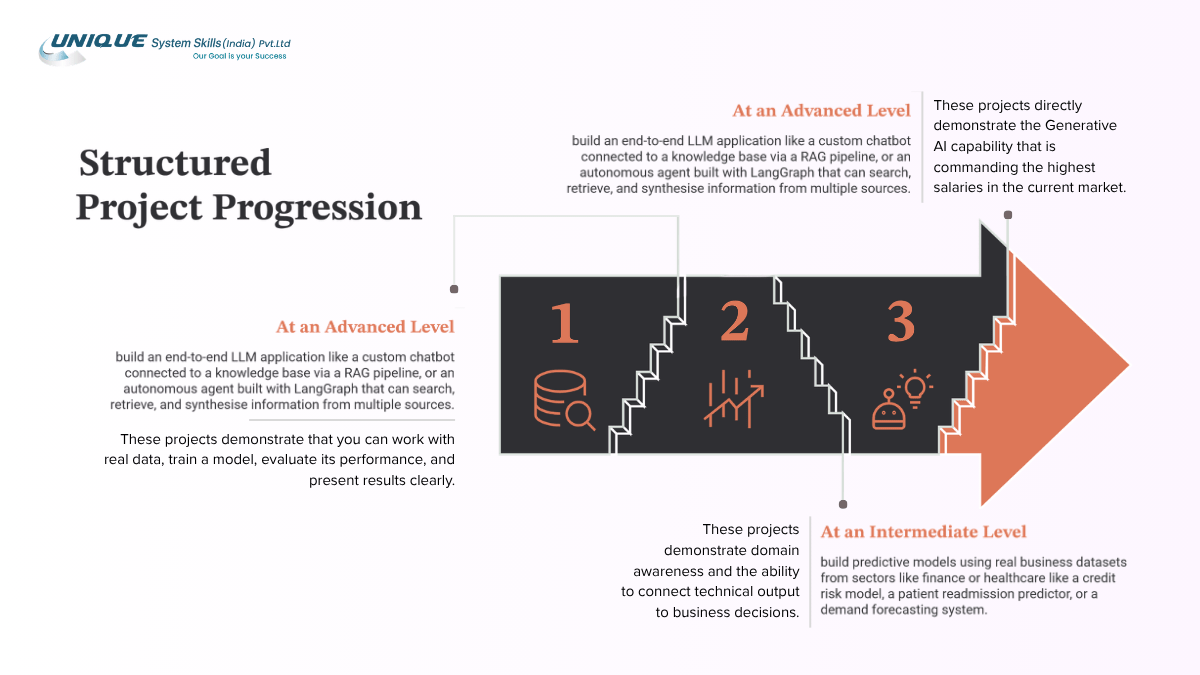
Structured Project Progression
These projects can be the beginning of your AI career path which is vast and highly diverse.
The key to making these artificial intelligence projects genuinely impressive is quantifying results. A project that shows “model accuracy improved from 71% to 89% through feature engineering and hyperparameter tuning” is dramatically more compelling than one that simply says “built a classification model.”
Artificial Intelligence Jobs in India — 2026 Salary Benchmarks
The artificial intelligence jobs landscape in India in 2026 is defined by strong demand, meaningful salary growth, and an increasingly distributed geography of opportunity. Bengaluru remains the AI Capital with mid-senior roles in the city pay between ₹15–40 LPA according to Naukri’s 2026 AI salary data.
Hyderabad is emerging as a strong alternative hub, driven by government-led AI missions and a lower cost of living that makes the effective purchasing power of an AI salary genuinely excellent. Mumbai dominates high-stakes FinTech AI with senior packages regularly reaching ₹35–50 LPA at top financial institutions. Pune and Chennai are anchoring themselves as reliable centres for IT services and SaaS-based AI development, with entry-level packages for freshers who can demonstrate practical skills running from ₹5–12 LPA, according to Glassdoor India’s AI freshers salary data.
For a detailed breakdown of specific artificial intelligence jobs and career pathways by role our blog on Artificial Intelligence Engineer Jobs provides a comprehensive role-by-role analysis. If cloud certification is part of your AI career strategy, the guide to Azure AI Certification in India covers how Microsoft Azure credentials fit into the broader AI job market.
The structural shift driving these salary numbers is not temporary. As banks, hospitals, retailers, and government departments race to build AI teams, the demand for professionals who can move from using AI tools to building AI systems is growing faster than the supply of qualified candidates. This gap is precisely the opportunity that the right training can help you access.
Why Unique System Skills Is the Right Training Partner for AI in 2026
The gap between completing an AI course and landing a high-paying artificial intelligence role is not always about knowledge, It is about the quality of practice, the depth of project experience, and the directness of the connection to hiring companies. Unique System Skills (USS) addresses all 3 through a training model built specifically for the realities of the 2026 Indian AI market.
Batch sizes are capped at a maximum of 15 students to ensure that every learner receives individual attention and has their questions answered in real time rather than waiting for a forum reply. As Maharashtra’s first USA-based IT training institute, USS brings an international standard to local AI education — particularly valuable for professionals targeting roles at MNCs or GCCs that apply global hiring benchmarks. USS’s dual role as both a training provider and an active staffing company means trainers teach the specific skills that recruiters in USS’s 350+ corporate partner network are actively screening for — not skills that were relevant two years ago.
360-degree career support includes technical mock interviews, resume building with quantified project descriptions, and unlimited interview calls until placement is achieved. View USS student outcomes and placement records here.
The Wave Is Here — Are You Building for It?
Artificial intelligence is no longer the technology of tomorrow. It is the technology of this quarter, this sprint cycle, and this hiring season. India’s position as the world’s second-largest AI talent hub, combined with a structural gap of more than 600,000 unfilled roles between current supply and projected demand, means that the professionals who invest in genuine, practical AI skills right now are entering a market that is actively competing for them.
With the right curriculum, the right tools practice, and the right portfolio of real projects, the path from where you are today to a meaningful artificial intelligence career in India is a structured, achievable journey. The wave is here. The question is whether you are building for it or watching it pass.
FAQ Section
Q1. What is Artificial Intelligence in simple terms?
Artificial intelligence is the ability of a computer system to perform tasks that would normally need human intelligence. These things include understanding language, recognising images, making decisions, and learning from experience.
Q2. What is the difference between AI, Machine Learning, and Deep Learning?
These 3 terms are often used interchangeably in casual conversation, but they describe different levels of the same technology stack.
Artificial intelligence refers to any system designed to perform tasks intelligently.
Machine Learning is a subset of AI and is the specific approach of training systems to learn from data rather than being programmed with explicit rules. A machine learning system is trained on thousands of spams and non-spam examples and learns the patterns itself.
Deep Learning is a subset of Machine Learning and uses multi-layered neural networks inspired loosely by the structure of the human brain to handle complex tasks like image recognition, speech synthesis, and natural language understanding.
Q3. Which artificial intelligence subjects should I study first as a beginner?
For someone starting from scratch, the order in which you study artificial intelligence subjects matters as much as what you study.
- Python basics.
- Statistics and probability basics.
- Machine Learning fundamentals
- Deep Learning
- Generative AI and LLMs.
- MLOps and Responsible AI
USS’s AI Fundamentals Course is structured around exactly this sequence, making it one of the most practically effective starting points for anyone new to the field.
Q4. What artificial intelligence tools are most in demand in India in 2026?
The artificial intelligence tools that appear most consistently in Indian job postings and hiring panel technical interviews in 2026 fall into four main categories.
For classical machine learning: Scikit-learn is non-negotiable. It implements virtually every classical with a clean, consistent API that makes it the first tool most employers test candidates on.
For deep learning: TensorFlow and Keras are the most widely used production frameworks in Indian enterprise environments. PyTorch is increasingly common in research and at product companies that work with cutting-edge architectures.
For Generative AI: OpenAI APIs, LangChain, and the emerging LangGraph framework are the tools behind the most in-demand applications in 2026. HuggingFace is the go-to platform for accessing, fine-tuning, and sharing open-source models.
For cloud deployment: AWS SageMaker, EC2, and S3 are the most widely used infrastructure tools for deploying AI models in Indian enterprise and GCC environments. AWS with DevOps proficiency connects the AI development layer to the production infrastructure layer that enterprise employers require before trusting a candidate with production systems.
Knowing your artificial intelligence tools at the level of practical implementation is what converts a theoretical understanding of AI into a hired, employed professional.
Q5. What salary can I expect from artificial intelligence jobs in India as a fresher?
Entry-level artificial intelligence jobs in India in 2026 offer starting salaries that vary meaningfully based on the role, city, and how well a candidate can demonstrate practical skills through a real project portfolio.
For freshers with zero to two years of experience who can demonstrate hands-on competence starting packages range from ₹5–12 LPA if they have a GitHub portfolio with real projects, at least one foundational certification, and the ability to walk through their code and methodology in a technical interview. Freshers who have specific Generative AI project experience are at the higher end of this range because supply is still catching up to demand in this specific area.
City matters significantly at the entry level. Bengaluru and Hyderabad tend to offer the highest absolute starting packages, while Pune offers comparable packages with meaningfully lower living costs. Read more about AI career pathways and role-specific salary progressions in our blog on artificial intelligence careers in India.